

I. The Problem of Translation
I painted this map with a deliberately hybrid ambition: to use contemporary cartographic accuracy — modern coastlines, proportional borders, legible spatial relationships — as a structural armature, while clothing that structure in the visual language, scripts, and aesthetic sensibilities of the early modern Ottoman world. My goal was not antiquarian reconstruction for its own sake, nor nostalgic pastiche, but a work that would be intelligible to a contemporary viewer while quietly acclimating them to the textures of an earlier epistemology. I wanted the map to read easily now while feeling as though it belonged to another time.
That framing — translation — is doing more work than it might initially appear to. Every map is a translation in some sense: a rendering of three-dimensional space onto two dimensions, of political complexity into color and line, of contested reality into apparently authoritative image. What I was attempting here was a second-order translation: taking the conventions of modern cartography and translating them into the visual grammar of a civilization whose relationship to space, sovereignty, and knowledge was organized around fundamentally different principles. The Ottoman world did not map itself the way we map it. To paint the empire in its own script and visual tradition while giving it the geographic precision of a contemporary map is therefore to stage a collision between two ways of knowing the world — and to hope that the collision is productive rather than merely jarring.
I believe I completed this map around 2020, though the research had been accumulating for years before that. I assembled a substantial personal archive of Ottoman atlases, manuscript maps, regional cartographic studies, and miniature painting sources. I can no longer fully reconstruct that archive, which I acknowledge as a limitation. What I can do is explain, as precisely as possible, the intellectual decisions the map embeds — because those decisions are the real essay.


My First Two Attempts at this Map (from sometime in the mid/late 2010s)
II. What the Map Shows, and When
The Ottoman Empire at its territorial zenith: the phrase requires immediate qualification, because "zenith" is a retrospective judgment that the Ottomans themselves would not have applied to any single moment. The empire's maximum territorial extent was reached not at one point but across a century of expansion, with different frontiers peaking at different times. The conquest of Egypt came in 1517. Suleiman the Magnificent's campaigns pushed the European frontier to the walls of Vienna in 1529 and consolidated Hungary and much of the Balkans by mid-century. The Arabian Peninsula, most of the North African coast, and the Caucasian borderlands were brought under varying degrees of Ottoman control across the sixteenth century.
The map's "zenith" corresponds most precisely to the reign of Mehmed IV (1648–1687), whose tuğra appears in the lower left cartouche — and whose reign, paradoxically, encompasses both the Ottoman Empire's last great expansion (the conquest of Crete, completed in 1669 after a twenty-four-year war; the campaign toward Vienna that reached its catastrophic end in 1683) and the beginning of its long territorial contraction.
The second siege of Vienna in 1683 is one of those events that functions as a historical hinge — the moment commonly identified as the point after which Ottoman expansion in Europe definitively reversed. The Grand Vizier Kara Mustafa Pasha led an army estimated at somewhere between 90,000 and 150,000 men to the walls of the Habsburg capital, established a siege that lasted two months, and was then broken by the relief army of Jan III Sobieski of Poland — the same Poland that appears on this map as پولونيا, rendered in the Ottoman form Polonya rather than the more familiar Lehistan. The choice of Polonya over Lehistan in my naming was determined by the source maps I consulted, but it carries an unintended historical irony: the Polonya whose king ended Ottoman expansion at Vienna is the same state whose eventual partition, less than a century later, would bring Russia — روسيه on this map, pressing against the Ottoman northeastern frontier — to borders it would hold for generations.
The map captures the empire in this specific suspended moment: its borders near their greatest extent, its visual culture at a high point of sophistication, and the mechanisms of its eventual contraction already in motion just beyond the frame.


A Work in Progress
III. The Tuğra and the Authority of the Calligraphic Sign
The most visually striking element in the map's lower left — more striking, I would argue, than the ornate cartouche bearing دولت عاليه عثمانيه (Devlet-i Aliyye-i Osmâniyye, the Sublime Ottoman State) or the miniature portrait of Mehmed IV — is the tuğra: the imperial monogram rendered in deep blue, its characteristic soaring loops rising above the baseline text.
The tuğra is one of the most extraordinary instruments of political authority in the pre-modern world. At its most basic, it was a signature — a calligraphic seal that headed every imperial document, edict, and treaty issued in the sultan's name. But to describe it merely as a signature is to miss what it was. Each sultan's tuğra was formally composed at the beginning of his reign by the court calligrapher, incorporating the sultan's name, his father's name, and the formula el-muzaffer daima (ever victorious) into a single calligraphic form whose conventions were fixed enough that a trained reader could immediately identify a sultan by his tuğra alone, yet distinctive enough that each was unrepeatable.
What this means for the map is that placing Mehmed IV's tuğra here is not a decorative choice. It is a legal act, or the visual representation of one. Every document that bore this sign was, in Ottoman administrative understanding, an extension of the sultan's personal authority — a fragment of sovereign power, dispersed through the empire's bureaucratic machinery by the act of inscription. The tuğra instantiated the sultan's presence. To place it on a map of the empire's extent is to make an argument about the relationship between the calligraphic sign and the territorial claim: that the empire exists, in some meaningful sense, through inscription — through the accumulated weight of documents bearing this mark, ordering, dispensing, recording, legitimizing.
This is why I wanted the tuğra rather than a coat of arms or a portrait alone. The Carolus Magnus map has the Karlsschrein border and the illuminated title — visual claims to authority drawn from the tradition of sacred kingship. The Ottoman equivalent is the tuğra: authority as calligraphy, sovereignty as script. The parallel with Carolingian minuscule — the reformed script that was simultaneously an administrative technology and a projection of imperial order — is one I find productive. Both empires, at their respective zeniths, understood that controlling the written sign was inseparable from controlling the territory it named.
IV. The Miniature Panels: A Visual Argument About Imperial Culture
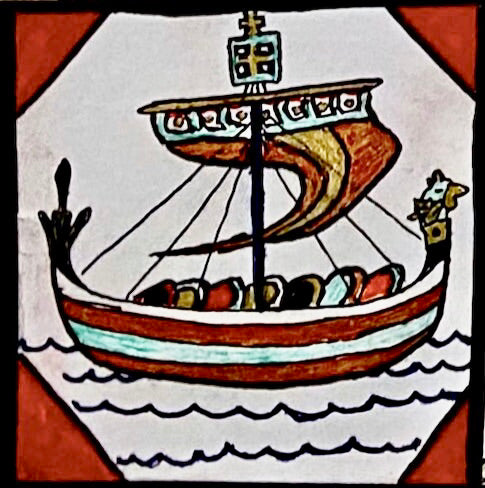
Running along the left and right margins of the map are eight miniature panels, each reproduced from Ottoman manuscript sources dating to the fifteenth through seventeenth centuries. Looking at the map carefully, one can identify their subjects: battle and cavalry scenes — Janissaries or sipahi cavalry in armor; court and reception scenes showing figures in the elaborate hierarchical arrangements of Ottoman protocol; a hunting scene; a sailing vessel; figures moving through landscape. These are drawn primarily from the Hünername and the Süleymannâme, the great illustrated histories commissioned by the Ottoman court.

Ottoman Miniature Used as Source Material
I want to say something about what the miniature tradition was, because it is frequently misunderstood by Western viewers accustomed to thinking of Islamic visual culture as strictly aniconic. The prohibition on representational images in Islamic theology was never absolute, and Ottoman court culture — building on Persian and Timurid miniature traditions absorbed through the conquest of Constantinople and the subsequent incorporation of diverse artistic inheritances — developed one of the most sophisticated traditions of manuscript illustration in the pre-modern world. The Ottoman nakkaşhane, the imperial painting workshop, produced illustrated histories, astronomical treatises, genealogical texts, and technical manuals whose visual conventions were as codified and as meaningful as any Western iconographic system.

Ottoman Miniature Used as Source Material
The miniatures I reproduced follow those conventions precisely, which is part of their historical interest. Ottoman miniature painting typically employs a high viewpoint, flattened perspective, and intense localized color — conventions that create a kind of simultaneous visibility, in which multiple events can be shown in a single frame without the spatial recession that Western perspective painting uses to imply temporal sequence. This is not a failure to achieve Western pictorial space; it is a different solution to the problem of how to represent time and action in a static image. The battle scenes along the map's margins are spatially immediate in a way that Western battle painting, with its atmospheric depth, is not: every figure is equally present, equally legible, equally real.

Ottoman Miniature Used as Source Material
Placing these panels as the map's frame rather than a geometric decorative border was a deliberate argument. Where the Carolus Magnus map frames itself with the Karlsschrein's metalwork ornament, this map frames itself with the Ottoman court's understanding of its own history — with images of the military campaigns, the ceremonial life, and the cultural production that constituted imperial identity. The border is the empire's self-representation, not an abstract ornamental system imposed from outside.
V. The Poets: What the Verse Is Doing
The six poetic excerpts that appear on the map alongside the miniature panels require more than presentation — they require reading. I selected them because they constitute, collectively, a philosophical argument about empire, knowledge, love, and the limits of worldly power that I wanted to hold in tension with the map's territorial confidence. Let me work through them.
Nasimi (İmadaddin Nasimi, c.1369–1417) opens the sequence:
منده صغار ايكی جهان من بو جهانه صغمازم
گوهرِ لا مكانم كون و مكانه صغمازم
Məndə sığar iki cahan, mən bu cahâna sığmazam
Gövhər-i lâ-məkân mənəm, kövn-ü məkâna sığmazam
Both worlds can fit within me, but in this world I cannot fit:
I am the placeless essence, but into existence I cannot fit.
Nasimi was an Azerbaijani Sufi poet of the Hurufi tradition, a mystical movement that identified the letters of the alphabet with divine emanation and the human form with the manifestation of God. He was executed in Aleppo in 1417, flayed alive for heresy — the Hurufi doctrine that the divine is fully present in the human being was considered dangerous blasphemy by the Sunni establishment. His verse is the most theologically extreme on the map, and I placed it first because its stakes are highest: the soul that cannot be contained by the world, the divine essence that exceeds all territorial claims. No map can hold Nasimi's subject. The juxtaposition of this verse with a map of imperial borders is itself the argument.
That Nasimi was executed in a city — Aleppo, حلب — that appears on this very map as an Ottoman provincial center is worth sitting with. The empire that contains Aleppo on its map could not contain Nasimi's thought within its orthodoxies. The map's confident territorial inscription and the poet's declared excess of all boundaries comment on each other across five centuries.
Fuzûlî (Mehmed Süleyman Fuzûlî, c.1494–1556) appears three times — more than any other poet — because he is, in my view, the most essential voice in the Ottoman classical tradition and the one whose range best mirrors the map's own range of concerns. Fuzûlî was an Azerbaijani Turkic poet who wrote simultaneously in Ottoman Turkish, Persian, and Arabic, composing a Divan — a collected lyric verse — in each language. This trilingual literary mastery is itself a kind of empire: a dominance of the three prestige languages of Islamic intellectual culture, exercised simultaneously. He lived and worked in Baghdad, then a frontier city of the Ottoman-Safavid rivalry, and his Leylâ vü Mecnun — his retelling of the great Arabic love story in Ottoman Turkish verse — is one of the defining texts of the entire Persianate literary tradition.
The three Fuzûlî lines I chose move through three distinct registers. The first is mystical and universal:
عاشق ايمش هر ن وار ﻋﺎﻝﻢ
ﻋلم بر قيل و قال ايمش آنجق
'Âşık imiş her ne var 'âlem
'İlm bir kîl ü kâl imiş ancak
All there is in the world is love.
And knowledge is nothing but gossip.
This is Sufi epistemology compressed to two lines: the Platonic-Islamic claim that eros — divine love, aşk — is the organizing principle of all reality, and that discursive knowledge (ilm) is, by comparison, merely noise. The line has been quoted and misquoted across centuries of Ottoman literary culture. Placing it on a map — an instrument of exactly the kind of discursive, classificatory knowledge Fuzûlî dismisses — is a deliberate act of self-subversion. The map names and orders the world; Fuzûlî says the world exceeds naming.
The second Fuzûlî line is something different entirely:
سلام وردم رشوت دگلدر ديو آلمادىلر
Selâm verdim rüşvet değildir deyü almadılar
I gave my greeting — they refused it, saying it was not a bribe.
This is Fuzûlî in his satirical register, and it comes from a real document: a petition (şikâyetname) he addressed to a government official after he was denied a promised stipend following the Ottoman conquest of Baghdad in 1534. The line is a joke about bureaucratic corruption, but it is also a precise social observation about how the Ottoman imperial machine actually functioned in practice — the gap between the sovereign's stated intentions and the administrative reality that officials mediated for their own benefit. It is the only genuinely comic line on the map, and I wanted it there because any honest picture of empire must include the experience of those who petitioned it and were turned away. The mystical Fuzûlî and the sardonic Fuzûlî are the same person. That range is part of what makes him essential.
The third Fuzûlî line is equally as human:
که خامهگی شکوهطرازِ غمِ عاشق
گزلر کی خامه شکو ده نمانه
Aşk derdinin devası füzun olmaz
Hastasıyım, şifa bulmam, beni yârsız
There is no cure for the pain of love.
I am sick; I will not find healing without my beloved.
Yes, the incurability of love's suffering — the dert that cannot be healed without the beloved. I will not linger on it except to note that in the Sufi tradition, the beloved (yâr) is simultaneously the human beloved of the ghazal convention and the divine beloved of mystical longing. Fuzûlî inhabits both meanings simultaneously. The empire that claims to govern the lands where this poetry was written has no jurisdiction over what the poetry is actually about.
Hayâtî Efendi's single line —
بر گل مى وار بو گلشن ﻋالمدﻪ خارسز
Bir gül mü var bu gülşen-i 'âlemde hârsız
Is there any rose, in this rosegarden world, without thorns?
— is the map's most concentrated image, and one of the most resonant in all of Ottoman lyric poetry. The rose garden (gülşen) is one of the Ottoman tradition's fundamental metaphors: for paradise, for the beloved, for the world itself in its beauty and its danger. The question is rhetorical — there is no rose without thorns — but it carries within it the entire Ottoman sensibility about worldly beauty as inseparable from worldly pain. For a map that depicts an empire at its most powerful and most beautiful, the question functions as a quiet warning. Every zenith contains its own thorns.
Nedîm (Ahmed Efendi, 1681–1730) closes the sequence, and his poem about Istanbul is the one that most directly engages the map's subject:
بو شهرِ استانبول كى بىمثل و بهادر
بر سنگينه يكپاره عجم ملكى فدادر
Bu şehr-i Stânbul ki bî-misl ü bahâdır
Bir sengine yek-pâre Acem mülkü fedâdır
O city of Istanbul, priceless and peerless!
I would sacrifice all of Persia for one of your stones.
Nedîm was the great poet of the Lâle Devri — the Tulip Era of the early eighteenth century, when Ottoman court culture reached a late flowering of aesthetic refinement under Ahmed III before the Patrona Halil rebellion of 1730 cut it short. His verse is the most worldly of the poems on the map: sensuous, urbane, in love with the physical city rather than with the mystical absolute. Where Nasimi cannot fit into the world, Nedîm cannot imagine leaving it.
The reference to Persia (Acem mülkü) is pointed. Iran appears on this map as إيران — the Safavid rival, outside the Ottoman boundary but named, present, and implicitly the measure of Ottoman grandeur. Nedîm's line says: not even all of Persia equals a single stone of Istanbul. It is the most explicitly imperial sentiment on the map, and I positioned it last because it brings the sequence back from mystical excess to the confident worldly beauty of the Ottoman capital — which is, after all, what the map itself is celebrating and questioning simultaneously.
VI. The Geography: An Ottoman World-View
Looking at the map's territorial scope through the lens of Ottoman geographic understanding rather than modern political categories reveals a different structure than the standard empire-map implies.
The Ottomans understood their empire not primarily as a bounded territorial unit but as the Memalik-i Mahruse — the "well-protected domains," a phrase that appears in the full title of the great Ottoman atlas of 1803 — organized around the sultan's personal sovereignty and administered through a hierarchical system of provinces (vilayets), sub-provinces (sancaks), and counties (kazas). The boundaries on this map are drawn with modern precision, but the Ottoman mental geography was organized around cities, routes, and administrative hierarchies rather than lines.
This is visible in how the map reads if you trace its named entities. أناطولي (Anatolia) sits at the center, as the empire's Anatolian heartland. Around it, the Balkans are densely labeled with their constituent territories: افلاق (Wallachia), رومايلي (Rumelia), ماجارستان (Hungary) — each name carrying its own history of conquest, negotiation, and administrative incorporation. The Arab lands are named with the geography of the Islamic tradition: بادية الشام (the Syrian Desert), جزيرة العرب (the Arabian Peninsula), دهنا (the Empty Quarter of Arabia). Nubia and Sudan appear in the south, marking the empire's African reach. The Safavid frontier with إيران (Iran) is one of the map's most significant silences — a boundary not of conquest but of contested stalemate, the result of a century of Ottoman-Safavid warfare that neither empire could resolve.
The choice of Ottoman place names throughout — gathered, as I have acknowledged, from period source maps rather than composed independently — means the map names the world as the Ottoman court named it. فرانسا (France) and آلمانيا (Germany) appear as external entities, named and acknowledged but clearly outside the empire's domain. روسيه (Russia) presses from the north — enormous, its scale a reminder that the entity which would eventually displace Ottoman power in the Caucasus and the Black Sea was already present on the horizon. The map does not predict the future. But the geography contains it.


VII. On Limits and the Honesty of Restraint
I am literate in Arabic script but not fluent in Ottoman Turkish. That admission belongs at the center of any honest account of this project.
Ottoman Turkish is one of the most demanding literary languages in the Islamic tradition: a composite of Turkic grammar with massive Arabic and Persian lexical borrowing, written in Arabic script whose conventions for Ottoman phonology are not always consistent, and read within a literary tradition whose full comprehension requires familiarity with the Arabic Quran, the Persian classical canon, and the Turkish vernacular simultaneously. Fuzûlî's trilingual virtuosity — the Divan in Ottoman, the Divan in Persian, the Divan in Arabic — is not an eccentric achievement. It is what mastery of Ottoman literary culture looked like.
I am not working at that level. The calligraphic conventions on this map are direct visual borrowings from historical sources rather than linguistically original compositions. Where a place name appeared consistently across multiple Ottoman-era maps, I adopted it. Where it did not, I made a conservative choice or accepted a generic label. Poland as بولونيا (Polonya) rather than لهستان (Lehistan) because Polonya was what my source maps showed. The Caucasus labeled generically rather than with invented or uncertain polity names. The Khivan Khanate as the simplified خيوا (Khiva) rather than a full Ottoman rendering I could not confidently verify.
Professor Mustafa Aksakal of Georgetown University helped me think through the historical framing and visual coherence of the project, and his input was essential. But the decisions — and the errors — are mine.
What I want to argue is that this restraint is itself an epistemological position. The alternative — filling every gap with plausible-seeming Ottoman Turkish, giving the map a false completeness — would have been a different kind of translation: one that effaces the translator's presence in favor of an illusion of seamless access. The silences and simplifications on this map are honest markings of where the translation becomes uncertain. A map that acknowledged no limits would be lying about what historical knowledge actually looks like.
This map is best understood not as a definitive historical document, but as a translation — between centuries, between visual grammars, and between ways of seeing the world. What I want to add now is that translation always leaves a residue: something that did not cross over, something that the target language cannot hold. The Ottoman world that this map tries to render in visible form exceeds the map's rendering of it. Nasimi said it better than I can: both worlds can fit within me, but in this world I cannot fit.
The empire is on the map. The map is not the empire. That gap — between the inscribed territory and the lived civilization — is where the poetry lives.
Selected Sources
Primary Texts and Historical Atlases
Hünername (Book of Skills). Istanbul: Ottoman court manuscript, 16th century. Topkapı Palace Museum Library.
Süleymannâme (Book of Suleiman). Istanbul: Ottoman court manuscript, 16th century. Chester Beatty Library, Dublin.
Memalik-i Mahruse-i Şahaneye Mahsus Mükemmel ve Mufassal Atlas (Complete and Detailed Atlas of the Well-Protected Domains of the Imperial State). Istanbul, 1803. Available via Wikimedia Commons.
Cedid Atlas (New Atlas). Istanbul, 1803. Library of Congress Geography and Map Division. https://www.loc.gov/resource/g3200m.gct00235/
Ottoman Poetry
Fuzûlî. Divan (Ottoman Turkish). Ed. Kenan Akyüz et al. Ankara: Türk Dil Kurumu, 1958.
———. Leylâ vü Mecnun. Trans. Sofi Huri. London: George Allen & Unwin, 1970.
Nasimi, İmadaddin. Divan. Baku: Azerbaijani Academy of Sciences, 1973.
Nedîm, Ahmed Efendi. Divan. Ed. Muhsin Macit. Ankara: Türk Dil Kurumu, 1997.
Secondary Sources
Ágoston, Gábor. The Last Muslim Conquest: The Ottoman Empire and Its Wars in Europe. Princeton: Princeton University Press, 2021.
Casale, Giancarlo. The Ottoman Age of Exploration. Oxford: Oxford University Press, 2010.
Fleischer, Cornell H. Bureaucrat and Intellectual in the Ottoman Empire: The Historian Mustafa Âli, 1541–1600. Princeton: Princeton University Press, 1986.
İnalcık, Halil. The Ottoman Empire: The Classical Age, 1300–1600. Trans. Norman Itzkowitz and Colin Imber. London: Weidenfeld & Nicolson, 1973.
Kafadar, Cemal. Between Two Worlds: The Construction of the Ottoman State. Berkeley: University of California Press, 1995.
Peirce, Leslie. The Imperial Harem: Women and Sovereignty in the Ottoman Empire. Oxford: Oxford University Press, 1993.
Roxburgh, David J. The Persian Album, 1400–1600: From Dispersal to Collection. New Haven: Yale University Press, 2005.
Schimmel, Annemarie. The Triumphal Sun: A Study of the Works of Jalaloddin Rumi. London: East-West Publications, 1978. (For the broader Persianate poetic tradition that shapes Ottoman literary culture.)
Cartographic Sources
Princeton University Library. Historical Maps of the Ottoman Empire. https://lib-dbserver.princeton.edu
Vilayets Atlas (Memalik-i Mahruse). https://commons.wikimedia.org/wiki/Category:Memalik-i_Mahruse-i_%C5%9Eahaneye_Mahsus_Mukemmel_ve_Mufassal_Atlas
Note: Many of the specific URL sources consulted during the original research phase of this project (c.2018–2020) are no longer accessible at their original addresses. The above scholarly sources represent a reconstructed bibliography that more accurately reflects the intellectual foundations of the work.