

I. An Honest Preface
I want to begin with something I don't usually do in these essays: an admission.
This map is the one I am least satisfied with. Not in its ambition — I think the ambition is right, and I'll defend it — but in its execution. The interior is crowded in ways that undermine the political hierarchy I was trying to argue for. The decorative border, which I intended to evoke West African textile and architectural traditions, is more generic than it should be. The Great Fulo territory, which should organize the map's middle distance, loses definition where I needed it most. There is a gap between what I set out to do and what ended up on the page, and I think the honest thing is to name it before proceeding.
I am also working further from my primary source base here than in almost anything else I've made. My HRE work is built on hundreds of pamphlets, Austrian state archive correspondence, and diplomatic records I've read firsthand. For West Africa in 1660, I am working primarily through secondary literature — the Cambridge History, the UNESCO General History, Thornton, Lovejoy, Levtzion — with the gaps that entails. The argument I'm making is historically defensible; it reflects genuine scholarly consensus. But there is a difference between making an argument from evidence you've handled yourself and making one from evidence you've absorbed through other people's handling of it, and I feel that difference in this essay more than in any other.
What I want to do here, then, is not simply describe the map but think through what it was trying to do, where it fell short, and why the subject itself remains — despite everything — one of the most important and underrepresented in the Western historical imagination.
II. Why 1660
The year is not arbitrary, though the precision is partly illusory.
1660 falls at a specific hinge point. The Moroccan Saadian invasion of 1591 — the army of several thousand arquebusiers that crossed the Sahara, defeated the Songhai at Tondibi, and shattered the political order of the Niger Bend — is far enough in the past that its consequences have had time to settle into new configurations. The large-scale consolidation of Atlantic colonial empires — the moment when European coastal presence hardens from trading-post dependency into something more coercive and territorial — is still several decades ahead. What 1660 offers, then, is a glimpse of a world in unstable equilibrium: trans-Saharan systems weakened but still functioning; Atlantic systems expanding but not yet dominant; African states still sovereign and, in most of the interior, the only powers that actually matter.
No single polity controls the frame. That is the argument. The map is structured not around empires alone but around zones of interaction: caravan corridors, river systems, forest-savanna transitions, the competitive littoral belt where European fort-builders depend absolutely on African brokers and rulers for access, protection, and commercial relationships they cannot unilaterally command. I wanted the map to feel like a world in motion rather than a political diagram, and I think in the coastal sections it achieves this. In the interior, less so.
III. The Trans-Saharan World after Empire
For centuries, West Africa's political and economic orientation had been northward. Gold from the Wangara fields, salt from Taghaza, kola nuts, and enslaved people moved along caravan routes linking the Niger basin to Morocco, Tunisia, and the Mediterranean. The cities of Oualata, Timbuktu, Djenné, Gao, and Agadez were not simply commercial nodes — they were centers of Islamic scholarship, legal culture, and manuscript production whose libraries rivaled anything in contemporary Europe. Ahmad Baba of Timbuktu, the great scholar deported to Marrakesh after the Moroccan conquest, reportedly owned 1,600 books — and lamented this as a fraction of what he had lost. That detail has stayed with me. It says something about the scale of what the 1591 invasion destroyed that tends to get lost when the event is described in purely political terms.
The invasion itself deserves more weight than it usually receives in the historiography of Atlantic Africa. Judar Pasha led an army of around four thousand men — mostly Spanish Moriscos and Andalusian renegades, equipped with arquebuses and light artillery — across nine hundred miles of Sahara in four months. The Songhai met them at Tondibi with a larger force and war elephants. The elephants panicked at the sound of gunfire and stampeded through their own lines. Songhai military dominance, built over a century of cavalry expansion under Sunni Ali and Askia Muhammad, collapsed in an afternoon. What followed was decades of Moroccan occupation, slave-raiding, and the gradual strangulation of the trans-Saharan commercial system the Songhai had sustained.
By 1660, the map reflects this disruption. The Saadian Pashalik around Timbuktu appears as geographically constrained and politically isolated — an assertion of authority without deep territorial integration, sustained by a garrison that was increasingly cut off from Moroccan support and drifting toward an autonomous local identity. The descendants of Judar Pasha's soldiers were becoming Arma, a new mixed community with their own political interests, no longer quite Moroccan and not quite Songhai. The map tries to show this ambiguity in how the Pashalik's territory is rendered, though I'm not certain it succeeds.
In the wake of Songhai's collapse, the political landscape of the western Sudan fragmented into successor states of varying vitality: Bambara polities centered on Ségou, Mandinka realms along the upper Niger and Gambia, the Empire of Kaabu on the Atlantic coast. Kaabu is one of the entities I most wish the map had done more justice to. A Mandinka successor state that had absorbed the political culture of the older Mali imperial tradition, it sat at the intersection of the trans-Saharan and Atlantic worlds, actively participating in slave-raiding and slave-trading toward the Portuguese trading posts at Cacheu and Ziguinchor. It would survive — remarkable continuity — until 1867, when it was finally destroyed by a Fula jihad. That longevity, in a region where most polities of the seventeenth century were gone or transformed beyond recognition within a century, suggests a political resilience the map labels but doesn't explain.
Willem Janszoon Blaeu, Africae nova descriptio, Amsterdam, 1630 (source)
IV. The Interior Mosaic
The interior is where the map's visual ambition most clearly outruns its execution, and where the historiographical challenge is genuinely hardest.
The problem is density. In the region the map covers, the seventeenth century hosts an extraordinary diversity of political forms: the cavalry states of the Mossi Kingdoms, resistant to both Islamic reform and Atlantic entanglement; the Hausa city-states of Kano, Katsina, and Zaria, whose craft production and long-distance commercial networks made them among the most economically sophisticated polities in the early modern world; the forest-savanna kingdoms of the south — Bono, Denkyira, Akwamu, emerging Ashanti — whose control over gold fields and kola routes made them indispensable to everyone who wanted to trade with the interior; the Oyo Empire, whose cavalry armies were building a dominance over the Yoruba states that would make it the dominant power of the region within a generation; the Kwararafa Confederacy, about which we know frustratingly little despite its evident military power; Nupe, Igala, Borgu.
The map tries to show all of this. In trying to show everything, it makes some things illegible. If I were making this map again, I would make harder choices about which entities to foreground and which to render as background — accepting that cartographic argument requires sacrifice, that you cannot insist on everything at once without diluting the insistence.
What I most want to say about the interior, and what the map can only gesture at, is that these states were not passive objects of Atlantic commercial pressure. They were agents who shaped the terms on which that commerce operated. The Asante would build a state partly financed by the gold and slave trades but structured around a sophisticated constitutional order, a professional army, and a bureaucratic administration that contemporary European visitors found genuinely impressive. Oyo's cavalry-based military expansion would make it the dominant supplier to the Slave Coast trade — not a victim of the Atlantic system but a participant who used it instrumentally, at devastating cost to the peoples it raided, for its own imperial purposes. The Hausa states negotiated with trans-Saharan merchants on one axis and forest-zone traders on another, managing commercial relationships of remarkable complexity without European intermediaries. None of this complicates the political argument I'm making — African states as primary, European presence as coastal and dependent — but it does complicate the moral simplicity that argument can sometimes imply.
V. The Coast: Dependency Runs Both Ways
The European fort-building along the Guinea coast is the part of the map I am most confident in, visually and historically. The compressed cluster of Portuguese, Dutch, English, French, Danish, Swedish, and Courlandic installations along the Gold Coast and Slave Coast — their competitive density, their architectural pretension, their cannon-bristling facades — reads clearly against the relative spaciousness of the interior. That contrast is the map's central visual argument and I think it lands.
What I want to add here is that European dependency on African rulers was not merely a temporary condition awaiting the arrival of superior force. It was structural, and it lasted longer than the standard narrative of European expansion acknowledges. The forts were built on land leased from African rulers who charged annual payments and retained the right to revoke access. The trade was conducted through African brokers — the caboceiros, the asientistas, the canoe-men who controlled the surf trade between fort and shore — without whom European merchants could not function at all. The rulers of Komenda, Elmina, Anomabo, and Whydah were not supplicants; they were partners in commercial relationships they were often better positioned to understand than their European counterparts, and they played competing European powers against each other with considerable sophistication.
The Dutch network is especially prominent on the map, reflecting their mid-seventeenth-century commercial ascendancy after displacing the Portuguese from Elmina in 1637. That ascendancy would itself prove temporary — the English would challenge it within a generation, and the internal political crisis of the rampjaar of 1672 would begin a long Dutch relative decline. The map catches the Dutch at their Atlantic peak, which is part of what makes 1660 an interesting moment.
The maritime routes arcing westward across the Aethiopian Ocean toward the Americas are the map's starkest intervention, and I want to be direct about what they represent. These are not trade routes in the abstract. They are the paths along which, between 1600 and 1660, somewhere in the region of half a million people were transported from the West African coast to Brazil, to the Caribbean, to the tobacco fields of Virginia. The lines on the map represent the Middle Passage: the specific horror of a specific commercial system that was, by 1660, already several generations old and still accelerating. I labeled it. I drew the ships. I don't think the map fully conveys the weight of what those lines mean, and I'm not sure any hand-painted map can. But I wanted them visible, and named, and pointed west.
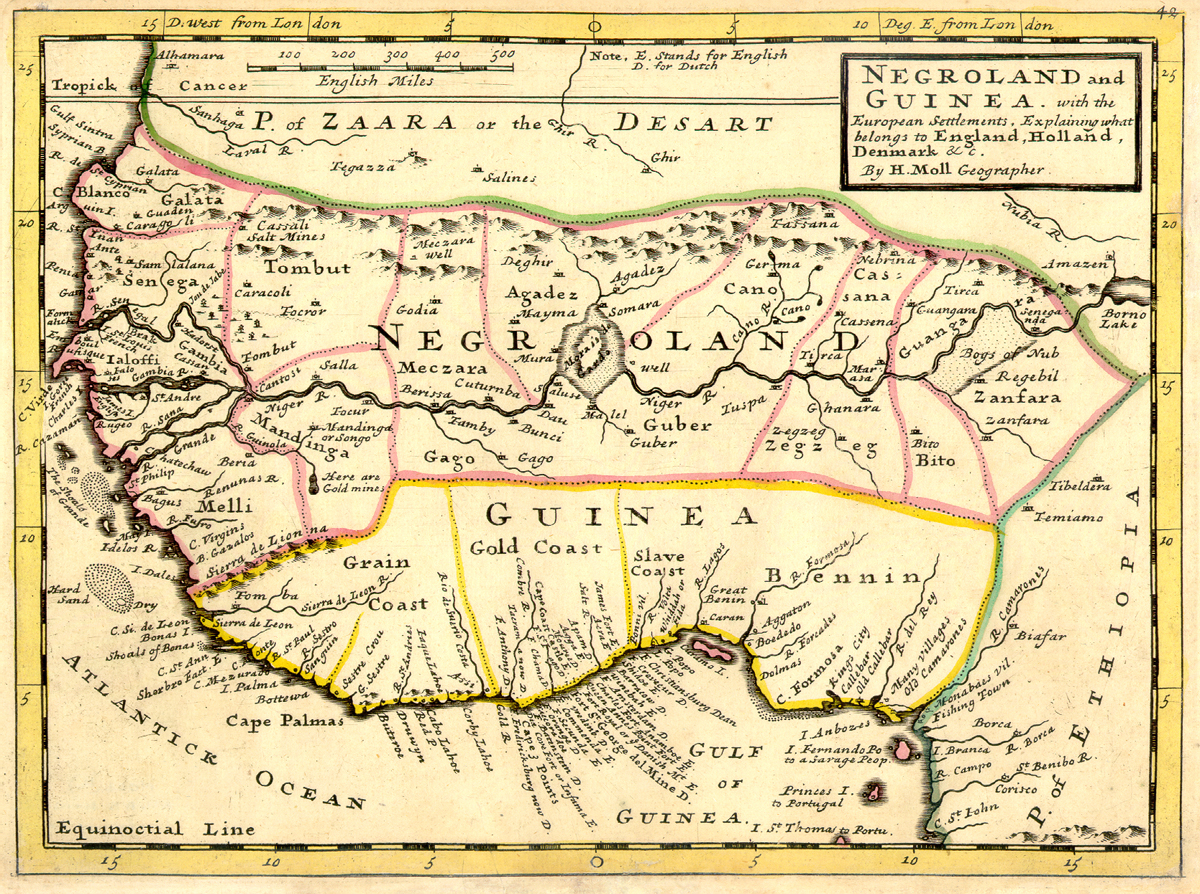
18th century Map of West Africa (source)
VI. Dahomey and the Question I Didn't Answer
The vignette panel depicting Abomey — the capital of Dahomey — is one of four images across the top of the map, alongside Fort Christiansborg, Gorée Island, and Timbuktu. I included it because by 1660 Dahomey was already beginning the military expansion that would make it, within a generation, one of the most formidable and morally troubling political entities in the Atlantic world.
Dahomey's relationship to the Atlantic slave trade is one of the most difficult subjects in the historiography of early modern Africa, precisely because it resists the narrative simplifications that both older European apologetics and more recent Afrocentric counter-narratives have tried to impose on it. Dahomey was not a passive victim of European demand. It was a militarized state that built its power partly through the systematic raiding and sale of enslaved people to European buyers at Ouidah — eventually establishing a royal monopoly over the trade that made the Dahomean king one of the wealthiest rulers in the region. Its famous corps of female soldiers, the Agojie, were among the instruments of that expansion. The wealth generated by slave-trading financed the court culture, the military, and the architectural program whose remains survive at Abomey today.
None of this is straightforward to depict or discuss. The map places Dahomey as one of the dynamic polities of the emerging Atlantic world, and that is accurate. But accuracy here carries a moral weight that a vignette panel and a bullet point don't begin to address. I'm not certain how to address it fully in a cartographic essay either. What I can do is name the discomfort rather than smooth it over, and acknowledge that the map's political argument — African states as primary agents, European presence as dependent — does not resolve into simple moral categories. Africans shaped the Atlantic world, including its worst institution. That shaping was real, consequential, and ought to be taken seriously rather than explained away.
VII. The Names on the Ocean
The use of Aethiopian Ocean for the Atlantic preserves an older European conceptual geography in which "Ethiopia" referred broadly to sub-Saharan Africa — a classical inheritance from Ptolemy and the medieval geographic tradition, rather than a modern racial category. That the Atlantic bore an African name in European usage until well into the seventeenth century is a minor fact that carries significant weight: it registers, however faintly, a European awareness that the ocean's western and eastern shores were connected through African presence and African commerce in ways that the later name "Atlantic" — with its associations of European navigation and mastery — tends to obscure.
The coexistence of Aethiopian Ocean with the commodity-coast names — Pepper Coast, Ivory Coast, Gold Coast, Slave Coast — reveals the map's conceptual stratification. One naming system is inherited from classical geography and looks inward, from Africa's perspective. The other is generated by Atlantic commerce and looks outward, from the European fort. Both naming systems are on the map because both were real in 1660, and the tension between them is part of what the map is trying to show.
The border was intended to draw on West African textile and architectural motifs — the repeating geometric patterns of strip-woven textiles, the carved reliefs of Saharan architectural traditions. Looking at it now, I think the claim is more aspirational than achieved. The pattern is geometric and rhythmic, but it is not specifically sourced in the way that, say, the Karlsschrein border on the Carolus Magnus map is specifically sourced. It looks like something I intended to be West African rather than something that unmistakably is. I mention this not to dismiss it — the intention was right — but because the difference between specific reference and general evocation matters, and I should have pushed harder to close that gap.
British Map of Africa, 1805 (source)
VIII. What the Map Argues, and What It Doesn't Quite Show
This map captures West Africa at a moment when outcomes were not foregone. Trans-Saharan systems were weakened but alive. Atlantic systems were expanding but structurally dependent on African cooperation. African states were sovereign, militarily capable, and commercially sophisticated, shaping the terms of engagement with both Moroccan armies and European merchants on terms that were not yet catastrophically disadvantageous.
That argument is historically correct. Scholars like John Thornton, Paul Lovejoy, and Nehemia Levtzion have spent decades demonstrating it against older assumptions of African passivity and European agency. I believe it. The map tries to make it visual.
What I am less satisfied with is whether the map succeeds in making it felt rather than merely asserted. The best cartographic argument is one where the visual grammar does the interpretive work — where you can see the political hierarchy without being told what to see. I think the coastal sections of this map achieve that. I think the interior sections often don't. The crowding that should communicate complexity instead communicates confusion. The states I most wanted to individuate — Kaabu, Dahomey, the Hausa cities, the Mossi kingdoms — lose their distinctiveness in the density.
This is the map I would most want to remake. Not to abandon its argument, which I stand behind, but to make the argument more legible — to let the visual do what I had to compensate for in the text. I'm not sure I've fully succeeded with the text either. But at least here I can say that directly, which the map itself cannot.
Bibliography (Selected)
Primary Sources and Contemporary Maps
Blaeu, Joan. Africae Nova Descriptio. Amsterdam, 1663.
Al-Sadi, Abd al-Rahman. Tarikh al-Sudan. Trans. O. Houdas. Paris: Ernest Leroux, 1900. (Chronicle of the western Sudan, written in Timbuktu in the 1650s — the closest thing to a contemporary primary source for the post-conquest Niger Bend.)
Leo Africanus [al-Hasan ibn Muhammad al-Wazzan]. Description of Africa. Trans. John Pory, 1600. (Written ca. 1526, so antedating our period by over a century, but essential for the geography and culture of the trans-Saharan world.)
Secondary Sources
Levtzion, Nehemia. Ancient Ghana and Mali. London: Methuen, 1973.
Lovejoy, Paul E. Transformations in Slavery: A History of Slavery in Africa. Cambridge: Cambridge University Press, 1983.
Thornton, John K. Africa and Africans in the Making of the Atlantic World, 1400–1800. Cambridge: Cambridge University Press, 1992.
Law, Robin. The Slave Coast of West Africa, 1550–1750. Oxford: Clarendon Press, 1991.
Wilks, Ivor. Asante in the Nineteenth Century. Cambridge: Cambridge University Press, 1975.
The Cambridge History of Africa, Volume 4: From c. 1600 to c. 1790. Cambridge: Cambridge University Press, 1975.
UNESCO. General History of Africa, Volume V: Africa from the Sixteenth to the Eighteenth Century. Berkeley: University of California Press, 1992.
Cartographic Sources
Princeton University Library. Historical Maps of Africa. https://lib-dbserver.princeton.edu/visual_materials/maps/websites/africa/maps-continent/continent.html
RareMaps. Africae Nova Descriptio (Blaeu) and related seventeenth-century maps. https://www.raremaps.com