
Note: This essay was written in 2019 as part of my art historical research at Georgetown University. It reflects a broader interest that also informs my cartographic work: how political power attempts to shape human perception through space, scale, and form. While the subject matter is architecture rather than maps, the underlying question is the same—how authority becomes legible, and how aesthetics are enlisted to mold collective experience.
Es ist überhaupt denkbar, daß die expressionistischen Architektur-Träume den großen Staatsbauten Hitlers angemessener gewesen wären als der Neoklassizismus
– Albert Speer, 1978[1]
In 1937, Alfred Kurella wrote in his Moscow-based periodical Das Wort that every convinced Expressionist artist and architect would inevitably follow Hitler and the Nazis.[2] A German communist and Soviet citizen, Kurella hated the artistic movement as much as he loathed Nazism. But already in 1933, Hitler had outlawed Expressionist art, which he deemed to be degenerate and derisively called Kulturbolschewismus.[3] None of the architecture promoted by the Nazi regime could accurately be considered Expressionist in style. Moreover, far more Expressionists, as it turned out, were seduced by the temptations of the hammer and sickle than by the swastika.[4] What relationship did Kurella see between the aesthetic of Expressionism and the ideals of fascism?
If at first glance it seems that there is no relationship, a deeper analysis reveals that Kurella was accurate in his assessment that a link existed between Expressionist architecture and Nazism. In particular, both groups interpreted the architect as a master of society who – through enormous, mystical, and overwhelming constructions – would bring utopia to earth. Of course, the designs of Nazi architect Albert Speer and those of Expressionists like Hans Poelzig, Bruno Taut, and Wassili Luckhardt are dissimilar in many ways. They differ with regards to their materials, their underlying ideology, and their styles. Nevertheless, both Nazis and Expressionists shared a belief in the immense power which architectural monuments held on the psychology of the populace.


Bruno Taut, Illustration “Monument to the New Law,” 1919 (top)
Albert Speer, “Deutsches Haus,” Paris, 1937 (bottom)
The Swedish critic Lars Olof Larsson understated the challenge of studying Nazi architecture when he wrote “An objective consideration and assessment of Albert Speer’s architecture is, to this date, still compounded with special difficulties.”[5] The architect Leon Krier was less subtle: “Like so many problems which are proudly ignored” he noted, “Speer’s projects continue, not unlike sex for the virgin, to be the object of prudish embarrassment for architects.”[6] Indeed, how can one objectively assess the architecture stemming from a genocidal and brutal regime? Would one even want to?
It is, in fact, a worthy task to make such an investigation in order to ensure the accuracy of our accounts of the past. Emily Braun asserted that current architectural historiography has ignored the connection between Expressionism and Nazi architecture, favoring the narrative of the historical victimization – and thus virtue – of modern art and architecture.[7] If correct, it is all the more necessary to reexamine the relationship between the supposedly retardataire fascist architecture and its modern, Weimar predecessors. According to Krier, the mere suggestion that Speer’s buildings could be beautiful is “taken as blatant provocation or as an indisputable mark of philo-Nazism.”[8] Such closed-mindedness is unhelpful. But at the same time, one must take Speer at his words when he wrote: “My buildings were not solely intended to express the essence of the National Socialist movement. They were an integral part of that very movement.”[9]


Wassili Luckhardt, Illustration, “Monument to Joy,” 1919 (top)
Bruno Taut, Illustration from Die Stadtkrone, 1919 (middle)
Albert Speer, Model, “Große Platz,” view from the Southwest (bottom)
Expressionist architecture developed at the beginning of the 20th century and gained prominence especially after the horrors of the First World War. Architects took advantage of new technologies and building materials, such as brick, steel, and especially glass, to build. Their constructions were often organic, revealing the impact of Jugendstil, and hearkened back to designs of nature – caves, mountains, cliffs, and hills.[10] Yet Baroque, Gothic, Egyptian, and Southeast Asian monuments, too, influenced the eclectic styles of the Expressionists.[11]
The men behind the buildings were guided by utopian, often socialist, outlooks. Bruno Taut’s hatred for contemporary urbanism is expressed in his book Die Auflösung der Städte from 1920; Erich Mendelsohn likewise argued that the buildings of the future needed to be horizontal in nature in order to break down class barriers.[12] Natural designs specifically did not follow the modernist mantra “form follows function” out of an Expressionist desire to rekindle individuality in an increasingly mundane world.[13] Any suggestion of repetition, industrialized manufacturing, and rationalization was scorned among expressionist architects,[14] who believed that their architecture would allow der Neue Mensch to experience a sense of inner spirituality that had been blunted by the alienation of modernity.[15]
Naturally, Expressionists architects felt they were uniquely capable of both understanding the challenges of modernity and of overcoming them. Thus, in 1919 Peter Behrens and German Bestelmeyer asserted in an Expressionist manifesto that the architect is “leader and lord of all artists.”[16] Adolf Behne agreed, and stated in 1919, “He who will not be a leader is no architect.”[17] If only they could govern, then Shangri-La could be realized. Their buildings, their city plans, and their monuments would achieve utopia, so they argued, because of psychological coercion. If architecture is truly the subtlest form of civilizing propaganda, and thus the greatest, at its extreme it could be manipulated to build the greatest civilization. As Bruno Taut concluded in 1918, “Henceforth, the artist as molder of the people’s experiences is alone responsible for the outward apparel of the new state.”[18]
For the Expressionists, it was not man who made buildings, but rather buildings that made man. Thus, in many of Bruno Taut’s illustrations there are no humans for scale – man as individual would be too aesthetically disruptive.[19] When people are shown, as in Wassili Luckhardt’s “Monument to Joy,” they are miniscule.[20] In his book Die Stadtkrone from 1919, Taut proposed a hierarchically ascending building complex as the centerpiece of the new city: at the top was a crystal building and universal symbol, a house of prayer for the faith of the future.[21] He wrote, “here at the summit the socially oriented hopes of the people find their fulfilment.”[22] In his illustration “Monument to the New Law,” Taut features verses from Nietzsche, Luther, Scheerbart, and others.[23] The architecture would improve the state of man, and the genius would design the architecture.


Wassili Luckhardt, Illustration, “Crystal on the Sphere,” 1920 (top)
Albert Speer, “Cathedral of Light,” Nuremberg, 1934 (bottom)
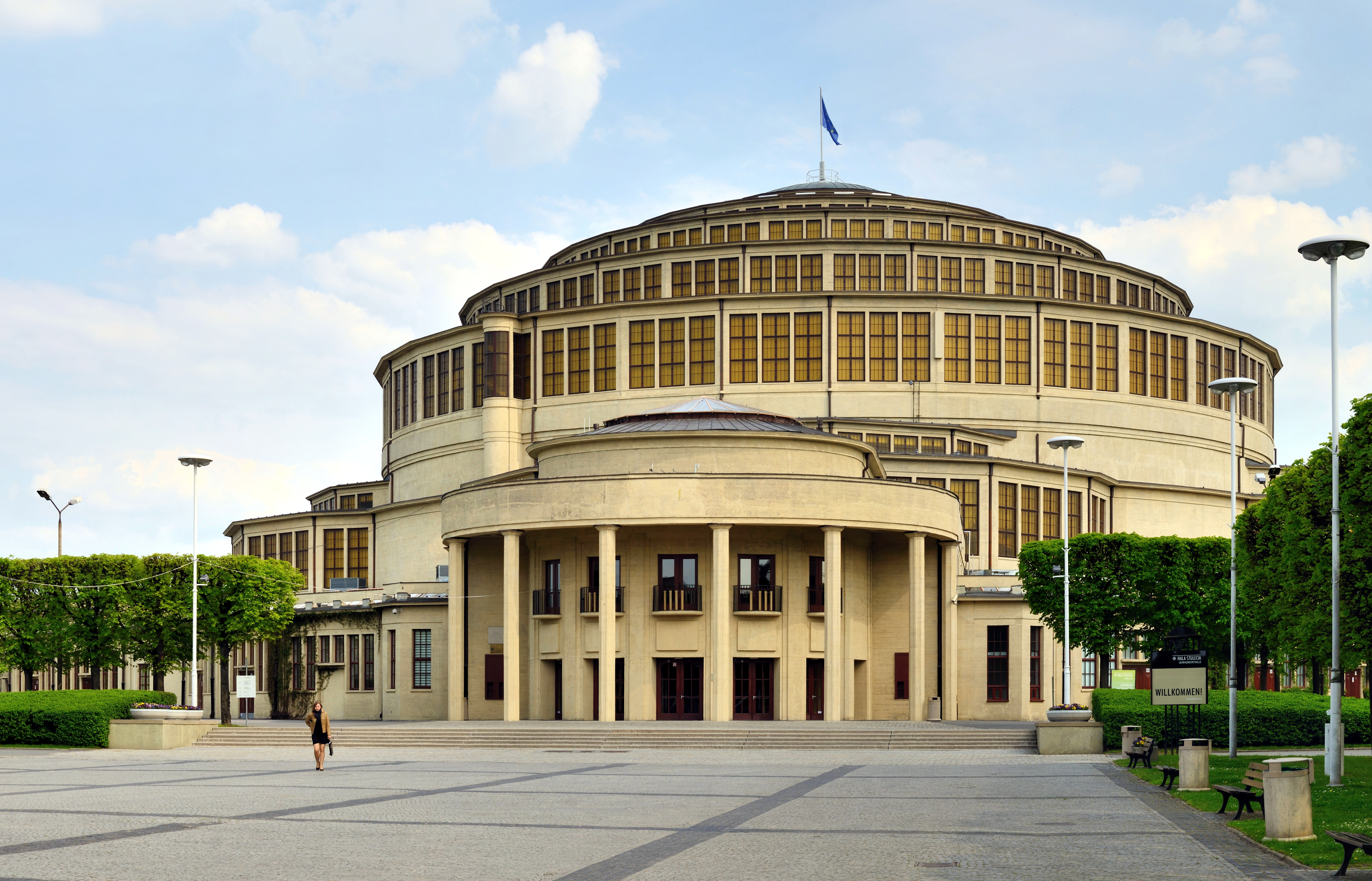
But in order for a building to have a psychological impact on a mass of people, it would need to be massive and dazzling. Hans Poelzig’s “Großes Schauspielhaus” of 1919, for instance, was enormous – it could hold 5,000 spectators.[24] Its atmosphere alluded to festivities and magic; Poelzig hoped to amaze the crowd rather than to satisfy the taste of an elite.[25] According to the impresario Max Reinhardt, the theater epitomized the people as an emotionally affected whole with a “sacred character.”[26] He went further: “The spectator must not have the impression that he is a mere uncommitted outsider, but must be fed the suggestion that he is intimately bound up with what is happening on the stage and that he too has a part to play in the unfolding of the action.” Other works of expressionist architecture, such as Max Berg’s “Jahrhunderthalle” from 1913, were similarly immense.[27]
Architecture is “the queen of the arts.”[28] It was no Expressionist who said this, but Adolf Hitler. Although Hitler and Speer had little taste for Expressionism, they found its enthronement of the architect suitable to the ideology of Nazi Germany. In particular, they agreed that architecture could be used to psychologically manipulate a population, and therefore to realize their version of utopia with the state as the new religion. Joseph Goebbels, who actually appreciated Expressionism but lost out to Alfred Rosenberg’s preference for the “völkisch” ideal, agreed. He liked its “programmatic deformation of reality,” and viewed it as an “adaptable means for fascist propaganda.”[29] Nazis envisioned Bruno Taut’s “Monument to the New Law” with verses appealing to fascism, not to socialism.


Hans Poelzig, Project for the Festspielhaus, Salzburg, 1920 (top)
Albert Speer, Model, North-South Axis, Berlin (bottom)
The premier architect of Nazi Germany later confirmed the significance of the psychological impact of his work. He recounted how, “When Hitler spoke of the effect of a building he had planned, he always referred to its power of suggestion. He would talk enthusiastically about the farmer who would travel all the way from the provinces to Berlin, enter the Great Hall … [and feel] literally crushed by what he saw.”[30] He also wrote that “The modern viewer can recognize a psychological intention in the buildings and projects of the Third Reich, an attempt to achieve effects through architectural means.”[31] The Nazis exalted of the irrationalism of a more primitive, spiritual, and genuine consciousness. In Speer’s architecture, he sought to overwhelm the individual, to evoke humility and respect in the face of the power of the state.
In order to do so, Speer took after the Expressionist architects’ love of magnitude and mysticism. Although the “crystalmania” which had so captivated the Expressionists did not continue after 1933, the Nazis, too, were fascinated by myths and cults.[32] Wassili Luckhardt’s illustration from 1920, “Crystal on the Sphere,” bears a resemblance to Speer’s “Cathedral of Light” at Nuremberg in 1934, a project which he considered his “most beautiful architectural concept.”[33] Both are concerned with evoking sentiments of awe and amazement among the onlookers or participants. Light and crystal are at the center of a new religion, the magic behind a new society.
The Zeppelinfeld where the Cathedral of Light was constructed was also colossal. It was 290 x 312 meters and could hold 90,000 Nazis – almost double the size of the thermal baths of Caracalla in Rome.[34] For Speer, enormity was the key to amazing a population and he even asserted, “The Seven Wonders of the World were selected more for their size than for their aesthetic merit.”[35] His other projects were similarly huge: the Great Hall of Germania would have held more than 180,000 people and the whole of Saint Peter’s could have fit inside just its oculus. The Great Plaza next to it could have held 1 million people; the planned Arch of Triumph would have been 50x larger than its counterpart in Paris; the Führer Palast was to be 40 meters high and 240 meters long; and the German Stadium had a capacity of 405,000.[36]


Max Berg, “Jahrhunderthalle,” Wrocław (Breslau),1913 (top)
Hans Poelzig, “Großes Schauspielhaus,” Berlin, 1919 (middle)
Albert Speer, Model, “The New Chancellery” (bottom)
Speer appreciated the emphasis of size in the work of the Expressionists. In 1978, he wrote that “Bruno Taut’s “City Crowns” [was] an attempt to unify geometry and chaos with oversized dimensions.”[37] Nevertheless, there are important differences between Speer’s buildings and those of the Expressionists: by and large, he considered Weimar modernists to be “poor wretches.”[38] Perhaps the most obvious difference is Speer’s preference for the Neoclassical. Coming from a family of successful and reputed architects, Speer admired the Prussian Neoclassicism of Friedrich Gilly and Karl Friedrich Schinkel from a young age.[39] This fondness only expanded as Speer became an assistant at age 22 under Heinrich Tessenow whose architecture expressed the national culture and favored simplified forms.[40] Throughout his life, Speer confirmed the great influence that the Wagnerschule and Nordic Classicism had on his architectural style.[41]
As a movement that emphasized order, harmony, and rationality – and that recalled antiquity – Neoclassicism opposed Expressionism’s emphasis on the irrational, the subjective, the organic, and the superfluous. Speer thought classical architecture to be supreme and confirmed that “the influence of the Altar or Pergamon was obvious” on his Nuremberg edifice.[42] The reason Speer so admired the Parthenon and the Colosseum was for their immense and awesome ruins. He recounted how “Hitler liked to explain that he was building to bequeath to the posterity the genius of his time. Because, in the end, only the great monuments recalled the great eras of history.”[43] This law of Nazi architecture demanded that all of the Reich’s buildings be constructed so as to inspire future generations.
Speer’s “Law of Ruins” is responsible for another distinction from Expressionism: the materials. Expressionist architects incorporated wood, brick, concrete, stained glass, and other decorative materials into their projects, but not stone.[44] All of these materials except for concrete cannot last for millennia. And as the great structures of the Reich were conceived “neither for the year 1940 nor for the year 2000, but to last for 1000 years,” per Hitler, they had to be constructed out of stone or concrete.[45] Speer reflected on the importance of building material: “Buildings built according to modern techniques were undoubtedly inappropriate for throwing out to future generations the “bridge of tradition” that Hitler demanded. It was unthinkable that heaps of rusty rubble might inspire heroic thoughts one day.”[46]
The only tangential relevance of the law of ruins to the ideas of the Expressionists is found in elements of Bruno Taut’s thinking. He affirmed that “Art seeks to be an image of death, to furnish the threshold at which mean preoccupation with earthly things dissolves in contemplation of that which opens up beyond death.”[47] For Taut, as for the Nazis, architecture could be meant to inspire thoughts of infinity and man’s meager place in it. Death, too, featured prominently in the Nazi worldview.

Albert Speer, “Zeppelinfeld,” Nuremberg, 1933
Expressionism and the architecture of Albert Speer are certainly distinct from one another. Nevertheless, the Nazis found utility in the Expressionists’ notion that architecture could be used to mold modern man. In fact, Expressionist architecture might have hypothetically been more successful than Speer’s Neoclassicism in realizing the Nazi ideal. Speer reflected that “Perhaps the filigree in certain of Hanz Poelzig’s projects, such as the one for the Salzburg Festival Theater, would have been a way of answering Hitler’s demands for immensity.”[48] Even more remarkable, he wrote that Expressionist architecture might have been better suited to Hitler’s purposes because it “shared the same agnostic mysticism, and was consciously barbaric,” akin to Nazi ideology.[49]
Albert Speer affirmed in 1978 that it was accurate to see “Hitler’s desire for power and the submission of others in my buildings.”[50] An analysis of the similarities and differences between Speer’s grandiose Neoclassical buildings and the conceptions of Expressionist architects reveals that the latter, too, could be used to psychologically coerce a population. Differences in materials, ideology, and styles between Nazi architecture and that of the Expressionists are clear. But what is also evident is the shared megalomaniacal ego of the architect – the idea that he who builds society shapes man. It is this terrifying belief in the psychological power of the architect over the masses which links Speer and the Expressionists and tyranny to architecture.
What the Nazis did to Expressionism, however, was as to the ghastly implementation to the utopia. The ideas which men like Bruno Taut and Erich Mendelsohn may have played with in their minds were never imposed on society. Expressionists could not have envisioned the horrific abuse of the ideas laid out in their sketchbooks by a totalitarian dictatorship. Nevertheless, the history of the relationship arouses poignant questions to contemporaries. If architecture indeed serves to legitimize tyrannical power, does that mean that all architects are of doubtful morality? If the buildings in which we live truly do have psychological effects on us, then are they for the better or for the worse?

Bibliography
Braun, Emily. “Expressionism as Fascist Aesthetic.” Journal of Contemporary History 31, no. 2 (April 1996): 273–92. https://doi.org/10.1177/002200949603100204.
“Jahrhunderthalle in Breslau.” Digital image. Wikipedia. Accessed April 9, 2019. https://upload.wikimedia.org/wikipedia/commons/c/cd/Wroc%C5%82aw_-_Jahrhunderthalle5.jpg
Lamoureux, Johanne. “La théorie des ruines d’Albert Speer ou l’architecture «futuriste» selon Hitler.” RACAR: revue d’art canadienne / Canadian Art Review 18, no. 1/2 (January 1, 1991): 57–63.
Lane, Barbara. “Review of ‘Albert Speer: Architecture 1932-1942.’” Journal of the Society of Architectural Historians 75, no. 2 (June 2016): 224–25. https://doi.org/10.1525/jsah.2016.75.2.224.
Pehnt, Wolfgang. Expressionist Architecture. New York: Praeger, 1973.
Speer, Albert, Georg Friedrich Koch, Lars Olof Larsson, and Karl Arndt. Albert Speer Architektur: Arbeiten 1933-1942. Berlin: Propyläen, 1995.
Speer, Albert, and Lars Olof Larsson. Albert Speer: Architecture 1932-1942. Edited by Léon Krier. Bruxelles: Archives D'Architecture Moderne, 1985.
[1] Albert Speer et al., Albert Speer Architektur: Arbeiten 1933-1942 (Berlin: Propyläen, 1995), 8. Translates to: It is even conceivable that Expressionist architectural dreams would have been more appropriate than Neoclassicism for Hitler's great state constructions.
[2] Wolfgang Pehnt, Expressionist Architecture (New York: Praeger, 1973), 206.
[3] Ibid., 203. “Cultural Bolshevism.”
[4] Bruno Taut and Erich Mendelsohn, for instance.
[5] Albert Speer and Lars Olof Larsson, Albert Speer: Architecture 1932-1942, ed. Léon Krier (Bruxelles: Archives D’Architecture Moderne, 1985), 233.
[6] Ibid., 217.
[7] Emily Braun, “Expressionism as Fascist Aesthetic,” in Journal of Contemporary History, 31 no. 2 (1996), 274.
[8] Speer and Larsson, Albert Speer: Architecture 1932-1942, 219.
[9] Ibid., 226. It is likewise important to know that Speer was aware of the Holocaust and was the minister for armaments and war production from 1942-1945.
[10] See, for instance, Hans Poelzig’s project for the Festspielhaus in Salzburg which was itself influenced by Baroque exuberance. Illustration at the end.
[11] Pehnt, Expressionist Architecture, 19.
[12] Ibid., 73.
[13] Ibid., 20.
[14] Ibid., 22.
[15] Ibid., 42. The Expressionists drew a lot of influence from the philosophy of Nietzsche, as the Nazis would later do.
[16] Ibid., 34.
[17] Ibid.
[18] Ibid., 89.
[19] Ibid., 73.
[20] See the illustration at the end.
[21] Pehnt, Expressionist Architecture, 206. See illustration at the end.
[22] Ibid.
[23] Ibid., 209.
[24] Ibid., 13. See illustration at the end.
[25] Ibid., 16.
[26] Ibid., 16-17.
[27] Ibid., 68. It was 67 meters long and exceeded what had hitherto been the biggest dome in the world: the Pantheon.
[28] Ibid., 206.
[29] Braun, “Expressionism as Fascist Aesthetic,” 274.
[30] Barbara Lane, “Review of ‘Albert Speer: Architecture 1932-1942,’” in Journal of the Society of Architectural Historians, 75 no. 2 (2016).
Johanne Lamoureux, “La théorie des ruines d’Albert Speer ou l’architecture «futuriste» selon Hitler,” in RACAR: revue d’art canadienne / Canadian Art Review, 18 no. 1/2 (1991), 60.
[31] Speer and Larsson, Albert Speer: Architecture 1932-1942, 213.
[32] Pehnt, Expressionist Architecture, 38.
[33] Lane, “Review of ‘Albert Speer: Architecture 1932-1942.’” See illustrations at the end.
[34] Johanne Lamoureux, “La théorie des ruines d’Albert Speer ou l’architecture «futuriste» selon Hitler,” in RACAR: revue d’art canadienne / Canadian Art Review, 18 no. 1/2 (1991), 60. See illustration at the end.
[35] Speer and Larsson, Albert Speer: Architecture 1932-1942, 213.
[36] Speer and Larsson, Albert Speer: Architecture 1932-1942, 84-85, 177; Lane, “Review of ‘Albert Speer: Architecture 1932-1942.’”
[37] Speer and Larsson, Albert Speer: Architecture 1932-1942, 213.
[38] Ibid., 226.
[39] Lane, “Review of ‘Albert Speer: Architecture 1932-1942.’”
[40] Speer and Larsson, Albert Speer: Architecture 1932-1942, 221 and 226.
[41] Ibid., 226. He specifically enjoyed the works of Otto Wagner, Carl Petersen, Aage Rafn, and Friedrich von Hohenstauffen.
[42] Lamoureux, “La théorie des ruines d’Albert Speer ou l’architecture «futuriste» selon Hitler,” 60.
[43] Ibid., 60.
[44] Pehnt, Expressionist Architecture, 8.
[45] Lamoureux, “La théorie des ruines d’Albert Speer ou l’architecture «futuriste» selon Hitler,” 57.
[46] Ibid., 58.
[47] Pehnt, Expressionist Architecture, 35.
[48] Speer and Larsson, Albert Speer: Architecture 1932-1942, 213.
[49] Ibid.
[50] Ibid.