

In 1760, the Qianlong Emperor composed a poem to celebrate the final defeat of the Dzungar Khanate, the last great nomadic empire of Inner Asia. The conquest had taken nearly a century of intermittent warfare across the steppe, and its completion more than doubled the territory under Qing control. Qianlong called the newly incorporated lands Xinjiang — 新疆, the New Frontier — a name that acknowledged the acquisition while asserting the permanence of the claim. The Dzungar people themselves did not survive the conquest as a people: what followed was among the most complete demographic destructions of the early modern period, a combination of military violence, famine, and epidemic that killed the overwhelming majority of a population that had numbered in the hundreds of thousands. The Qing empire of 1760 was at its greatest territorial extent. It was also standing on the result of what some historians have called the last genocide of the Mongol world.
This map does not depict that violence. No historical map does. What it depicts is the shape that the violence left behind: an empire stretching from Manchuria to the Pamirs, from Mongolia to Vietnam, containing within its borders a greater diversity of peoples, languages, religions, and administrative traditions than any other state on earth at that moment. Understanding what the map is showing requires understanding what the Qing empire actually was — which is a different thing from what later nationalist historiography, both Chinese and otherwise, has claimed it was.

Qing Era Painting (source)
The Object
Before the argument, the map itself. The interior is washed in pale yellow-gold, the color of Qing imperial silk, with a river system traced in blue — the 黃河 and 長江 threading through 內地, the Chinese heartland, their courses the most familiar geography on the page. The empire's outer boundary is drawn in a heavy red-orange line with a flame-like inner edge, confident and unambiguous: this is where the Great Qing ends. Beyond it, the tributary states and neighboring powers — 印度, 俄羅斯, 朝鮮, 日本 — appear in a cooler ground color, present but unincorporated, named but not claimed.
The internal divisions are treated differently from the outer boundary: softer lines, graduated rather than absolute, suggesting that the empire's internal zones were not separated by the same kind of hard sovereignty that distinguished Qing territory from everything outside it. This is historically accurate. The Qing administered its frontier zones through differentiated systems — the Banner system in Manchuria, the League-Banner (jasagh) system in Mongolia, the Ambans in Tibet, the military colonies in Xinjiang — not through a single homogenized model of rule. The map's visual treatment encodes this: firm at the edges, graduated within.
The border program frames all of this in the visual vocabulary of Qing court art: blue-and-gold dragon panels rendered in the five-clawed imperial style, four corner roundels with shou (壽, longevity) medallions, and six columns of classical Chinese poetry running three to a side. The map functions simultaneously as geographic argument and literati object.
The Empire That Was Not China
Qing Era Festival Robe (source)
The standard mistake when looking at a map of the Qing dynasty is to see China. The territory largely overlaps with the People's Republic of China today, which encourages the retrospective assumption that the Qing were governing a Chinese state that happened to be ruled by Manchu emperors. This assumption is what the map is designed to correct.
大清 — the Great Qing — is not 中國 (Zhongguo), the Middle Kingdom, the conventional Chinese self-designation. The Qing court maintained a deliberate distinction between the dynasty's name and the Chinese cultural-geographic concept. The dynasty's rulers were Manchu, descended from the Jurchen people of northeastern Manchuria who had built a distinct political and military culture before conquering China proper in 1644. The Qing emperors presented themselves differently to different subjects: as Son of Heaven (天子) and Confucian sovereign to Han Chinese subjects, as Khan to Mongolian subjects, as patron of Tibetan Buddhism to Tibetan and Mongolian Buddhist subjects, and as the Great Qing Khan in the Manchu tradition. This was not hypocrisy or political theater — it was a sophisticated theory of imperial authority that held the empire together across its extraordinary ethnic and cultural diversity.
The map makes this visible through its regional labels. 內地 — the interior, literally "inner land" — designates the eighteen provinces of Han Chinese administration: the bureaucratic heartland governed through the civil examination system and Confucian administrative conventions. But 內地 occupies only a portion of the map's yellow-gold interior. Surrounding it, clearly distinguished, are: 外蒙古 (Outer Mongolia) and 內蒙古 (Inner Mongolia), governed through the League-Banner (aymag-khoshuu) system adapted from Mongolian tribal organization; 西藏 (Tibet), administered through the Dalai Lama's Ganden Phodrang government under Qing suzerainty; 青海, the Qinghai plateau with its mixed Tibetan and Mongolian population; 準部 and 回部, the Dzungarian and Muslim regions of what would become Xinjiang; and 東三省, the Three Eastern Provinces of Manchuria — the dynasty's ancestral homeland, kept deliberately separate from the Chinese administrative system and restricted to Manchu settlement for most of the Qing period.
These are not provinces of China. They are components of a multiethnic Inner Asian empire that contained China as one of its constituent parts.
The Title and Its Scripts
The map's title cartouche carries two scripts: 大清 in Chinese characters, and below it the same name in Manchu script — ᡩᠠᡳᠴᡳᠩ (Daicing), the Manchu reading of the dynasty's name. This bilingualism was not decorative. The Qing court conducted its administration in both Chinese and Manchu simultaneously: imperial edicts, legal documents, diplomatic correspondence, and examination records were produced in both languages throughout the dynasty's existence. When the bilingual administrative system began to break down in the nineteenth century — when Manchu literacy declined among the Banner population and the dynasty increasingly relied on Chinese-language administration alone — historians have identified this as a symptom of the dynasty's gradual transformation from an Inner Asian empire into something closer to a Chinese state.
The Manchu script on this map insists on 1760, the moment before that transformation had begun. At that date, the Qianlong Emperor was composing poetry in Manchu, conducting Buddhist ceremonies in Tibetan, receiving Mongolian princes at the imperial hunting grounds at Chengde, and governing Chinese provinces through an administrative apparatus that had barely changed since the Ming. The bilingual title holds all of that simultaneously.
The date 1760 marks not only the completion of the Dzungar conquest but the brief moment of maximum territorial consolidation: after the absorption of Xinjiang and before the beginning of the long nineteenth-century contraction. It is the Qing empire at its fullest extent and, in some respects, its most itself — the moment when its multiethnic, multilinguistic, multi-administrative character was most completely realized.

A bilingual edition of “The Romance of the Western Chamber,” 1710 (source)
The Poems
Six columns of classical Chinese poetry frame the map's interior, three on each side, separated by dragon medallions. Read together, they constitute an interpretation of the empire at its height, and that interpretation is more complex and more melancholic than the map's triumphalist territorial claims might suggest.
1. Zheng Xie (鄭燮, 1693–1765) — 《題畫竹》Inscribed on a Painting of Bamboo
两枝修竹出重霄,Two tall stalks of bamboo pierce through layered sky,
几叶新篁倒挂梢。A few leaves of new shoots hang downward from the tips.
本是同根复同气,They share the same root, breathe the same breath
有何卑下有何高!What is there, then, that is low, and what is high?
Zheng Xie (better known by his studio name Zheng Banqiao, 郑板桥) was one of the Eight Eccentrics of Yangzhou and the most celebrated painter-poet of bamboo in Qing literary history. He spent his life painting the same three subjects — orchid, bamboo, and stone — integrating calligraphy, painting, and poetry into unified compositions in the wenren (literati) tradition. His bamboo was never merely botanical; it was always a self-portrait, a study in resilience and moral uprightness under pressure. This poem, less famous than his 《竹石》but characteristic of his voice, turns on the final couplet: the bamboo stalks of different heights share identical root and breath. The question — what, then, is high and what is low? — cuts against the entire Confucian hierarchy of rank and station. On a map of an empire organized by rigid gradations of sovereignty, tribute, and administrative category, it is a quietly subversive opening.
2. Yuan Mei (袁枚, 1716–1797) — 《偶成》Impromptu
有寄心常静,When the mind has something to rest on, it is always calm;
无求味最长。The flavor of not-seeking is the longest-lasting.
儿童擒柳絮,Children try to catch willow catkins,
不得也何妨!What does it matter if they catch nothing?
Yuan Mei was the great Qing poet of xing ling — genuine feeling, spontaneous expression — whose retirement from official life to his Garden of Ease (隨園) in Nanjing became the emblem of an independent literary existence outside the court. He resigned his magistracy at thirty-three, purchased the estate that had been described in Dream of the Red Chamber, and spent the rest of his long life writing, teaching (including female students, in defiance of Confucian convention), and eating well. His philosophy of no-seeking is not passivity but a principled refusal to organize one's inner life around striving and acquisition. The image of children chasing willow catkins — delighted, unconcerned with outcome — is the poem's argument in miniature. His presence here alongside the Qianlong Emperor's poem creates a deliberate counterpoint: court achievement and the pleasures of its refusal, placed side by side.
3. The Qianlong Emperor (乾隆帝, 1711–1799) — 《喜鵲》The Magpie
喜鹊声唶唶,The magpie chatters and calls,
俗云报喜鸣。Folk wisdom says it sings to announce good fortune.
我因望雨候,But I have been waiting and watching for rain
偏厌此时听。And find I cannot bear to hear it just now.

Qing Era Artistic Depiction of a Pair of Magpies (source)
The Qianlong Emperor composed more than 40,000 poems over the course of his reign — a volume without precedent in Chinese literary history, and itself a political performance of Confucian literati authority by a Manchu ruler. Poetry, in the classical Chinese tradition, was the highest expression of cultivated sensibility; prolific imperial poetic output was proof, produced in extraordinary quantity, that the conquest dynasty had genuinely absorbed the cultural values of the civilization it governed. This poem turns on an unexpected note of imperial irritation. The magpie (喜鵲) is one of the most beloved omens in Chinese popular culture, its chatter traditionally interpreted as the announcement of good news. But the emperor, preoccupied with the agricultural anxiety that was always the sovereign's most intimate and inescapable responsibility, is waiting for rain — and the magpie's cheerful noise, announcing fortune he has no use for at this moment, is not comforting but actively unwelcome. 偏厌此时听: "I find I particularly cannot bear to hear it just now." It is a remarkably unguarded line for a sovereign poem: not philosophical detachment, not imperial serenity, but a man annoyed by a bird because his mind is on the harvest. Among the forty thousand, it is one of the more human.
4. Gu Yanwu (顧炎武, 1613–1682) — Untitled (from 《亭林詩文集》)
翡翠年深伴侣稀,The kingfisher grows old; its companions have grown few,
清霜憔悴减毛衣。The cold frost has wasted and thinned its plumage.
自从一上南枝宿,Ever since it first settled on the southern branch,
更不回身向北飞!It has never once turned back to fly north.
Gu Yanwu is the most politically charged presence on this map. A Ming loyalist who witnessed the Qing conquest of 1644 as a young man, he refused throughout his life to serve the new dynasty, spending decades in itinerant scholarship across north China, carrying the archives of the destroyed Ming state in carts, writing the foundational works of evidential scholarship (kaozheng xue) that would paradoxically be taken up and institutionalized under the very Qing patronage he refused. He died unreconstructed, in 1682, still refusing to call himself a subject of the Great Qing.
The bird imagery in this poem belongs to a tradition of Ming loyalist writing in which the refusal to fly north — toward Beijing, toward the Qing capital, toward service under the conquerors — was a coded declaration of political allegiance. The kingfisher that settled on the southern branch and will never return north is Gu Yanwu himself: settled in his refusal, wasted by years of resistance, but immovable. To include this poem on a map celebrating the Qing empire at its 1760 peak is to place inside its decorative frame the voice of a man who explicitly refused what the map depicts. By 1760, Gu's scholarship had been so thoroughly absorbed into the Qing intellectual mainstream that quoting him could be read as pure literary citation. But the poem's content is unmistakable, and its placement adjacent to the imperial seal makes the juxtaposition particularly acute: the dynasty's legal claim and its most eloquent refusal, side by side.
5. Cao Xueqin (曹雪芹, c. 1715–1763) — from 《紅樓夢》Dream of the Red Chamber
衔山抱水建来精,Gathering mountains and embracing waters, built with exquisite skill,
多少工夫筑始成。What immense labor it took to raise it to completion.
天上人间诸景备,All the scenes of heaven and earth are gathered here,
芳园应锡大观名。This fragrant garden deserves the name: Grand View.
This poem appears in Chapter 18 of Dream of the Red Chamber (紅樓夢), composed within the novel by the character Jia Zheng for the dedication of the Grand View Garden (大觀園). Cao Xueqin was writing in the Qianlong era, and Dream of the Red Chamber — the greatest novel of Qing literature — is a meditation on the rise and fall of a great aristocratic family whose prosperity peaks early and collapses entirely by the novel's end. The Grand View Garden, built at enormous expense to receive an imperial consort's visit, stands at the center of this arc: its construction marks the family's zenith, and its gradual decay runs parallel to everything that follows. To quote a poem about the Grand View Garden on a map of the empire at its 1760 height is to introduce, however quietly, the shadow of that height's end. The garden was built at enormous cost and is already fading by the final chapters; the empire was built at enormous cost and was already beginning to strain under the weight of its own scale. What immense labor it took to raise it to completion can be read in more than one register.
6. Huang Jingren (黄景仁, 1749–1783) — 《癸巳除夕偶成》Impromptu on New Year's Eve, 1773
千家笑语漏迟迟,A thousand households ring with laughter as the water-clock drips slowly;
忧患潜从物外知。Yet hidden worries rise from somewhere beyond the world of things.
悄立市桥人不识,Quietly I stand upon the market bridge—no one recognizes me.
一星如月看多时。A single star, bright as the moon, I watch for a long time.
Huang Jingren was a late Qianlong-era poet who died at thirty-five, having spent most of his short life in poverty and minor official obscurity, writing some of the most finely melancholic poetry of the dynasty. This poem — one of a pair composed on New Year's Eve 1773, when Huang was twenty-four — is a portrait of a man standing outside public celebration: the households are lit and laughing; the water-clock drips slowly in the stillness of the holiday; the speaker stands on a market bridge, unrecognized, watching a single star so bright it seems like the moon. The hidden worry that rises from "somewhere beyond the world of things" is the anxiety of the man who cannot find his place in the order that surrounds him — who sees the celebration from the outside and feels not envy but a private, inexplicable dread.
On a map of imperial glory at its maximum extent, this poem insists on the experience of those for whom the empire's triumph is irrelevant to their inner life. It is the final word in a sequence that moves from literati idealism (Zheng Xie) through philosophical contentment (Yuan Mei) and imperial authority (Qianlong) into refusal (Gu Yanwu) and elegy (Cao Xueqin) and arrives here, at the edge of the celebration, with a young man gazing at a star that resembles the moon but is not. The empire is at its height. Not everyone is inside.
The Dragon Medallions and the Eight Banners
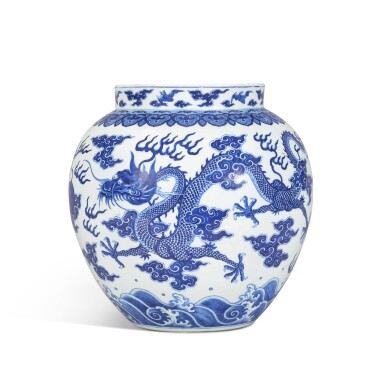
Qing Era Porcelain Bowl (source)
The dragon roundels and panels that separate the poems and frame the map's border represent more than decorative convention. The Eight Banners (八旗) were the fundamental military and social organization of the Qing state — the institutional structure through which the Manchu conquest had been organized and through which Manchu identity was maintained throughout the dynasty's existence.
Established by Nurhaci in the early seventeenth century, the Banner system initially organized Manchu warriors into eight units distinguished by colored flags: yellow, white, red, and blue, each in bordered and plain variants. As the Qing empire expanded, Mongol Banners and Han Chinese Banners were added, but the Manchu Banners remained the dynasty's military and social core. Banner families received stipends, lived in segregated quarters in major cities, and were theoretically prohibited from engaging in commerce or agriculture — maintained as a warrior caste in permanent readiness. By 1760, the Banner system had become as much an identity structure as a military one: Bannermen were Qing subjects in a way that Han civilians were not, connected to the dynasty by a different and more intimate bond.
The dragon imagery throughout the border draws on the imperial visual vocabulary of Qing court art — specifically the five-clawed dragon (五爪龍) reserved for imperial use — rendered in the blue-and-gold color scheme associated with Qing imperial porcelain. This palette was itself a product of the Qing dynasty's most distinctive artistic achievement: the collaboration between Chinese painters and Jesuit missionaries at the imperial court, which produced a hybrid visual language combining European illusionism with Chinese compositional conventions. The Jesuits — most prominently Giuseppe Castiglione (郎世寧), who spent fifty years at the Qing court and became one of Qianlong's most trusted artists — worked alongside Chinese painters to create images that were simultaneously inside and outside both traditions: neither purely Chinese nor European, but something the Qing court had made for itself. This map's decorative program draws on that tradition, situating the geographic argument within a visual language that is itself a product of the empire's cosmopolitan self-understanding.
The Imperial Seal
The square cartouche at the lower right of the map bears the Qing imperial seal in red-bordered seal script (篆書). Imperial seals in the Qing system were not merely signatures: they were juridical instruments whose impression on a document transformed it into a legally binding expression of imperial will. The Qianlong Emperor was known for his seal collecting — he accumulated hundreds of seals and impressed them prolifically on paintings, calligraphy, and documents throughout the imperial collection, sometimes to the considerable dismay of art historians who must read through his colophons to reach the original object beneath.
Placing the seal on a hand-painted map is a statement about what kind of object the map is: not a neutral geographic document but an act of imperial claim, a legal instrument as much as a visual representation. The territory the map depicts is not merely described, it is asserted.
The Traditional Geographic Vocabulary
Throughout the map, geographic names follow eighteenth-century Chinese practice rather than modern standardization: 西洋 (Western Ocean) for the Indian Ocean, 南海 (South Sea) for the South China Sea, 東海 (East Sea) for the sea between China and Japan, and 黃海 (Yellow Sea) for one of the few names that passed unchanged into modern usage. These are not merely historical labels; they are a different cognitive geography, organized around Chinese spatial orientation rather than European cartographic conventions. The sea names radiate from the Chinese coast as near and far, south and east and west — the ocean named from the inside, from the perspective of the civilization at its center.
Taiwan appears as 臺灣, incorporated into Qing administration since 1683. The tributary states along the southern border — 越南, 暹羅 (Siam), 東埔寨 (Cambodia), 緬甸 (Burma) — are present but not claimed: they appear beyond the empire's red-orange boundary, signaling the tribute relationship's deliberate ambiguity. They acknowledged Qing suzerainty in the ritual language of the tributary system; they governed themselves. The boundary between the empire and its tributaries was never the clean line that European cartographic conventions require, and the map's treatment — present but unincorporated, named but not colored — is more historically accurate than a sharp border would be.
Qing Era Scroll (source)
Sources and Research
Historical Atlases
Herrmann, Albert, and Georg Westermann. History and Commercial Atlas of China. Cambridge: Harvard University Press, 1935. [Map 41.]
Secondary Sources
Cohen, Paul A. History in Three Keys: The Boxers as Event, Experience, and Myth. New York: Columbia University Press, 1997.
Elliott, Mark C. The Manchu Way: The Eight Banners and Ethnic Identity in Late Imperial China. Stanford: Stanford University Press, 2001.
Millward, James A. Eurasian Crossroads: A History of Xinjiang. New York: Columbia University Press, 2007.
Perdue, Peter C. China Marches West: The Qing Conquest of Central Eurasia. Cambridge: Harvard University Press, 2005.
Rawski, Evelyn S. The Last Emperors: A Social History of Qing Imperial Institutions. Berkeley: University of California Press, 1998.
Artistic Sources
Castiglione, Giuseppe (郎世寧), Jean-Denis Attiret, Ignace Sichelbart, and Jean Damascene. Court paintings for the Qianlong Emperor, including the Conquest of Xinjiang series. Engravings executed in Paris under Charles-Nicolas Cochin at the Académie Royale by Le Bas, Aliamet, Prévot, Saint-Aubin, Masquelier, Choffard, and Launay.
Shen Quan (沈銓), Wang Gai (王概). Classical bird-and-flower painting and the Jieziyuan Huazhuan (芥子園畫傳) tradition.
Qing imperial porcelain and silk embroidery from the Qianlong period, particularly famille rose (粉彩) and blue-and-white (青花) traditions.
Poetry Sources
Gushimi classical Chinese poetry database: https://www.gushimi.org/shiren/qingdai/
Chinese calligraphy reference: https://www.chinese-tools.com/tools/calligraphy.html
Manchu script reference: https://manc.hu/en/login